OSI & TCP/IP Models
Overview
These two models are the mental framework for understanding and troubleshooting any network communication — from a single Wi-Fi drop to a full packet capture analysis.
Key concepts
- OSI layers 1-7
- TCP vs UDP
- Ports
- Packets, frames, MAC addresses
- TCP/IP's four layers
How it works
OSI Model
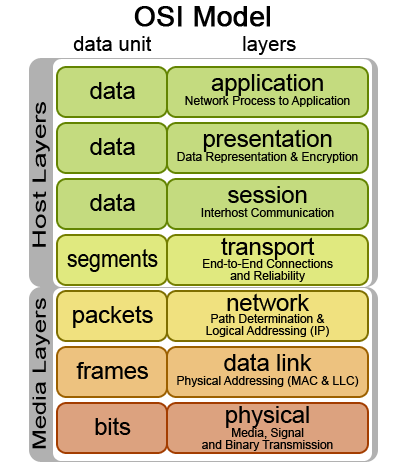
OSI (Open Systems Interconnection) is a seven-layer model explaining how data travels through a network. Each layer has a different responsibility and helps IT professionals troubleshoot communication problems systematically.
Layer 7 — Application
Closest to the user and network applications. Provides network services to programs such as browsers, email clients, and messaging platforms.
Layer 6 — Presentation
Prepares data so another system can understand it — handles formatting, encryption, decryption, and compression.
Layer 5 — Session
Starts, manages, and ends communication sessions between devices, keeping communication organized during an exchange.
Layer 4 — Transport
Manages delivery of data between devices, using TCP and UDP to control how data is sent.
- TCP (Transmission Control Protocol) — connection-oriented and reliable; checks that data arrives correctly and in order.
- UDP (User Datagram Protocol) — connectionless and faster; doesn't confirm every piece of data arrives.
- Ports — numbered communication endpoints. An IP address identifies a device; a port identifies the service running on it.
Layer 3 — Network
Manages logical addressing and routing, using IP addresses to identify devices and routers to move packets between networks.
- Packet — a small unit of data sent across a network; large data is divided into packets for transmission.
- Router — connects separate networks, using destination IP addresses and routing tables to decide where packets go.
Layer 2 — Data Link
Handles communication between devices on the same local network, using MAC addresses and packaging data into frames.
- MAC address — a hardware address assigned to a network interface, identifying a device's adapter on a local network.
- Frame — the Layer 2 form of network data, containing source and destination MAC address info.
- Switch — connects devices within the same local network, using MAC addresses to forward frames.
Layer 1 — Physical
Sends raw bits across physical or wireless connections — cables, connectors, radio signals, hubs, and network-interface hardware.
TCP/IP Model
TCP/IP is the main networking model used by the internet, with four layers.
Application Layer
Combines the OSI Application, Presentation, and Session layers — includes protocols applications use to communicate.
Transport Layer
Handles communication between applications and devices, using TCP and UDP.
Internet Layer
Handles IP addressing and routing, moving packets between different networks.
Network Access Layer
Handles communication on the local network — MAC addressing, Ethernet, Wi-Fi, cables, and network adapters.