IP Addressing & Subnetting
Overview
IP addressing and subnetting are how individual devices get identified and organized within and across networks — core knowledge for both Network+ and Security+.
Key concepts
- IPv4 vs IPv6
- Public vs private vs loopback addresses
- Default gateway, subnet mask
- CIDR notation
- Network address vs broadcast address vs usable hosts
How it works
IP Addressing
An IP address is a logical address assigned to a device on a network so information can be sent to the correct destination.
IPv4
Uses 32-bit addresses written as four decimal numbers separated by periods. Has a limited number of available addresses.
IPv6
Uses 128-bit addresses, providing a much larger address space than IPv4. Addresses use hexadecimal values separated by colons.
Public IP Address
Reachable through the internet — ISPs assign these to internet-connected networks and services.
Private IP Address
Used inside a local network — not directly routable across the public internet.
Loopback Address
Refers to the same device that sends the traffic — used to test network software and services locally.
Default Gateway
Sends traffic from a local network to other networks — commonly a router.
Subnet Mask
Separates the network portion of an IPv4 address from the host portion, helping a device determine whether another address is local or on a different network.
Subnetting
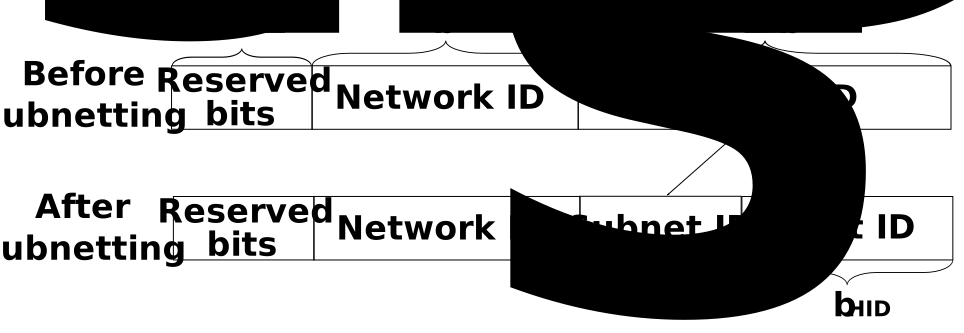
Subnetting divides a larger network into smaller networks, improving organization, reducing broadcast traffic, and separating groups of devices for performance and security.
CIDR Notation
Classless Inter-Domain Routing — uses a slash and number to show how many bits are used for the network portion of an address (e.g. /24).
Network Address
Identifies the subnet itself — cannot normally be assigned to an individual device.
Broadcast Address
Sends traffic to every device within the same subnet — cannot normally be assigned to an individual device.
Usable Host Addresses
The addresses actually available for devices on a subnet — the count depends on the subnet mask/CIDR prefix length.